A personal trainer I know tried a VR cycling app for the first time last spring. She’s been in fitness professionally for eleven years, seen every piece of equipment and every workout trend that’s come through, and is genuinely hard to impress. She used it for forty minutes and sent me a message that just said “I didn’t notice I was working that hard.”

That’s the whole pitch for immersive fitness technology, really. Not the headset, not the frame rate, not the technical spec — the fact that the experience is absorbing enough that effort stops feeling like effort. It’s the same reason spinning classes with good music and a loud instructor outperform solo stationary bike sessions at the same intensity. The brain’s relationship with perceived exertion is malleable, and immersive environments exploit that in ways flat screens simply don’t.
The teams building this well are the ones who understood that insight before they touched a line of code. Fitness App Development Services that treat AR and VR as a novelty layer on top of a standard workout app tend to produce impressive demos that users open twice. The ones treating immersive tech as a fundamental rethink of how motivation and movement interact are building something with genuine retention behind it.
Here’s what that actually looks like in practice.
What VR Fitness Is Actually Doing to Perceived Exertion
There’s real research behind the “I didn’t notice I was working that hard” observation, not just anecdote. Studies on immersive exercise environments consistently show that participants in VR conditions report lower perceived exertion at the same objective workload compared to non-immersive conditions. The mechanism isn’t fully settled scientifically, but the working theory is attention — when cognitive resources are occupied by navigating an environment, processing spatial information, and responding to dynamic stimuli, fewer resources are available to consciously register physical discomfort.
For fitness applications this is genuinely significant. Perceived exertion is one of the primary reasons people stop mid-workout and one of the primary reasons they avoid starting the next one. Technology that meaningfully reduces it without reducing the actual physiological stimulus is doing something that decades of motivational content and progress tracking features have never quite managed.
This is why the most successful VR fitness products — rowing through fjords, cycling through mountain passes, boxing against virtual opponents — aren’t primarily in the business of workout programming. They’re in the business of sustained attention. The workout is the mechanism. The experience is the product.
Where AR Fits Differently
Augmented reality in fitness occupies a different space from VR, and the distinction matters for how it gets built.
VR replaces the environment entirely. AR layers information onto the real one. That difference determines what each technology is actually useful for in a fitness context.
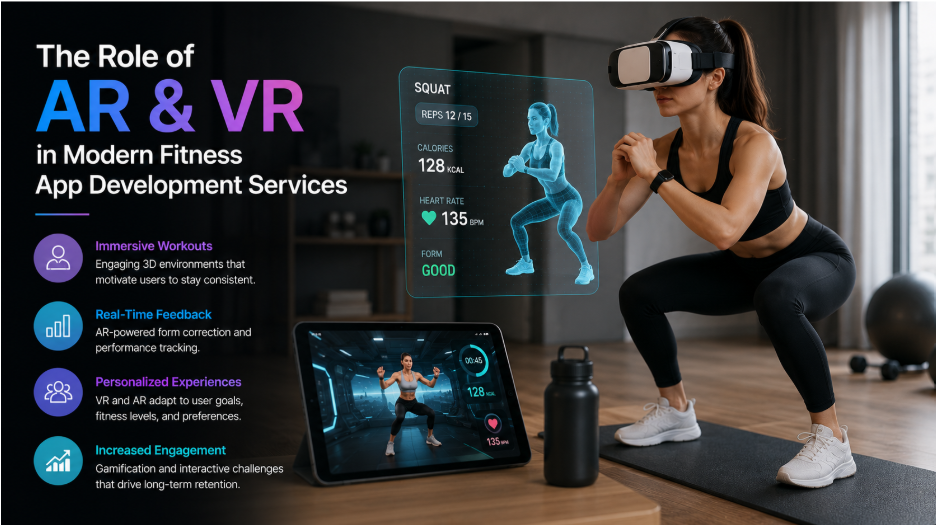
AR’s strongest fitness application right now is form correction. A phone camera watching someone perform a squat, an overhead press, a deadlift, can overlay real-time feedback directly onto the movement — joint angles, range of motion, alignment cues appearing in the camera view as the movement happens rather than after it. This is technically demanding to build well. The underlying pose estimation needs to be fast enough that feedback arrives in real time rather than after the correction window has passed, accurate enough that it doesn’t produce false positives that confuse or discourage users, and forgiving enough to handle the variation in how different bodies move through the same pattern.
Teams that have built this well are the ones who treated the pose estimation layer as a distinct engineering problem requiring genuine expertise, not a feature that could be assembled from existing computer vision libraries with minimal customization.
The Retention Problem Neither Technology Solves Automatically
Here’s the thing about immersive fitness technology that doesn’t get said enough: novelty isn’t retention.
VR fitness apps have had notable drop-off problems even when the core experience is genuinely impressive. A thirty-minute VR cycling session through Iceland is remarkable the first time, engaging the fifth time, and potentially routine by the fifteenth. The psychological mechanism that makes immersive environments effective at reducing perceived exertion doesn’t necessarily make them effective at driving users back week after week over months.
The fitness apps using AR and VR that show real long-term retention are the ones that combined immersive technology with the same engagement loops that drive retention in non-immersive fitness apps: progression systems that meaningfully evolve, social and competitive features that create ongoing stakes, personalization that makes the experience feel increasingly fitted to a specific user rather than increasingly familiar.
Immersive tech amplifies a good retention strategy. It doesn’t replace one.
AR and VR Are Transforming Fitness Apps at the Infrastructure Level Too
The conversation about AR and VR in fitness tends to focus on user experience. The infrastructure implications get less attention and are equally significant for anyone building seriously in this space.
High-fidelity VR environments require content pipelines that are genuinely different from standard video or audio content. 3D environments need to be built, rendered, and updated. User movement data needs to be processed in real time, often locally on the device to keep latency low enough that the experience doesn’t become nauseating. The storage, bandwidth, and processing requirements for a quality VR fitness library are substantially larger than for an equivalent library of recorded workout videos.
AR at the level of real-time form correction involves on-device machine learning inference — the pose estimation model running locally rather than in the cloud, because the round-trip latency of cloud inference is too slow for real-time feedback. Building, training, and optimizing that model for fitness-specific movements is a different kind of engineering work from standard app development.
Development teams without genuine experience in these infrastructure realities tend to underestimate what quality AR and VR fitness features actually require to build and maintain, which produces either features that don’t work well enough to be useful or timelines and budgets that expand dramatically past original estimates once the real requirements become clear.
The Hardware Reality and What It Means for Reach
Any fitness app building on VR has to make a decision about hardware dependency, and it’s a genuinely difficult one.
Standalone VR headsets have improved dramatically and become considerably more affordable, but the installed base is still a fraction of the smartphone user base. Building VR fitness features that require a headset is building for a smaller, more specific audience. Building AR features that run on a smartphone camera reaches a vastly larger one but gives up the immersive depth that makes VR’s effect on perceived exertion so significant.
The fitness apps navigating this most thoughtfully are building tiered experiences — full VR for users with headsets, AR through the phone camera for users without, standard guided video as the baseline — with a shared progression system and community layer that works across all three modes. This is more complex to build than committing to one approach, but it avoids the audience segmentation problem that comes from betting entirely on hardware that most users don’t yet own.
What to Actually Build First
For fitness businesses evaluating where to start with immersive technology, the honest answer is usually AR before VR, and form correction before environment replacement.
AR form correction has a clearer value proposition that’s easier to communicate, works on hardware users already own, and addresses a genuine need — most people exercising without a coach have no real feedback on whether they’re moving correctly — that flat-screen workout apps have never satisfactorily solved. It’s also a feature with strong retention implications, because a tool that meaningfully improves someone’s movement quality over time becomes genuinely hard to replace.
VR environments are compelling and the technology continues to improve, but the content investment required to build a library that doesn’t feel repetitive, combined with the hardware dependency, makes it a higher-stakes bet for most fitness businesses at their current stage.
Starting with the technology that delivers the clearest value to the most users, and building toward the more immersive experience as both the content library and the hardware base mature, tends to be a more durable path than leading with the technology that generates the most impressive demo.
The Development Partner Question
Building seriously in AR and VR fitness requires a development team with a specific combination of skills that’s genuinely uncommon: mobile development depth, computer vision expertise for AR, 3D environment and content pipeline knowledge for VR, and enough fitness product understanding to build features that actually drive the behavior they’re supposed to drive.
The team to look for isn’t the one with the most impressive VR demo. It’s the one that can explain specifically how they’d handle pose estimation accuracy for different body types, how they’d build a content pipeline that can grow without requiring complete rebuilds, and how they’d approach retention design in an immersive context where novelty will eventually wear off.
Those are harder questions to answer than “can you build a VR workout app.” But they’re the questions that determine whether what gets built actually holds up.